The image of a meteorite evokes something foreign, unfamiliar—a presence infused with a rare power to set things in motion. However subtly, its influence radiates out into the world, into the cosmos, quietly but surely leaving its mark.
Yes, even as a mere image, the meteorite casts its influence upon our lives, in this world, in this very moment, on Tokyo as a city, the Earth as a planet—upon the greater universe, upon this reality we inhabit. That is why I named the performance arts festival Autumn Meteorite.
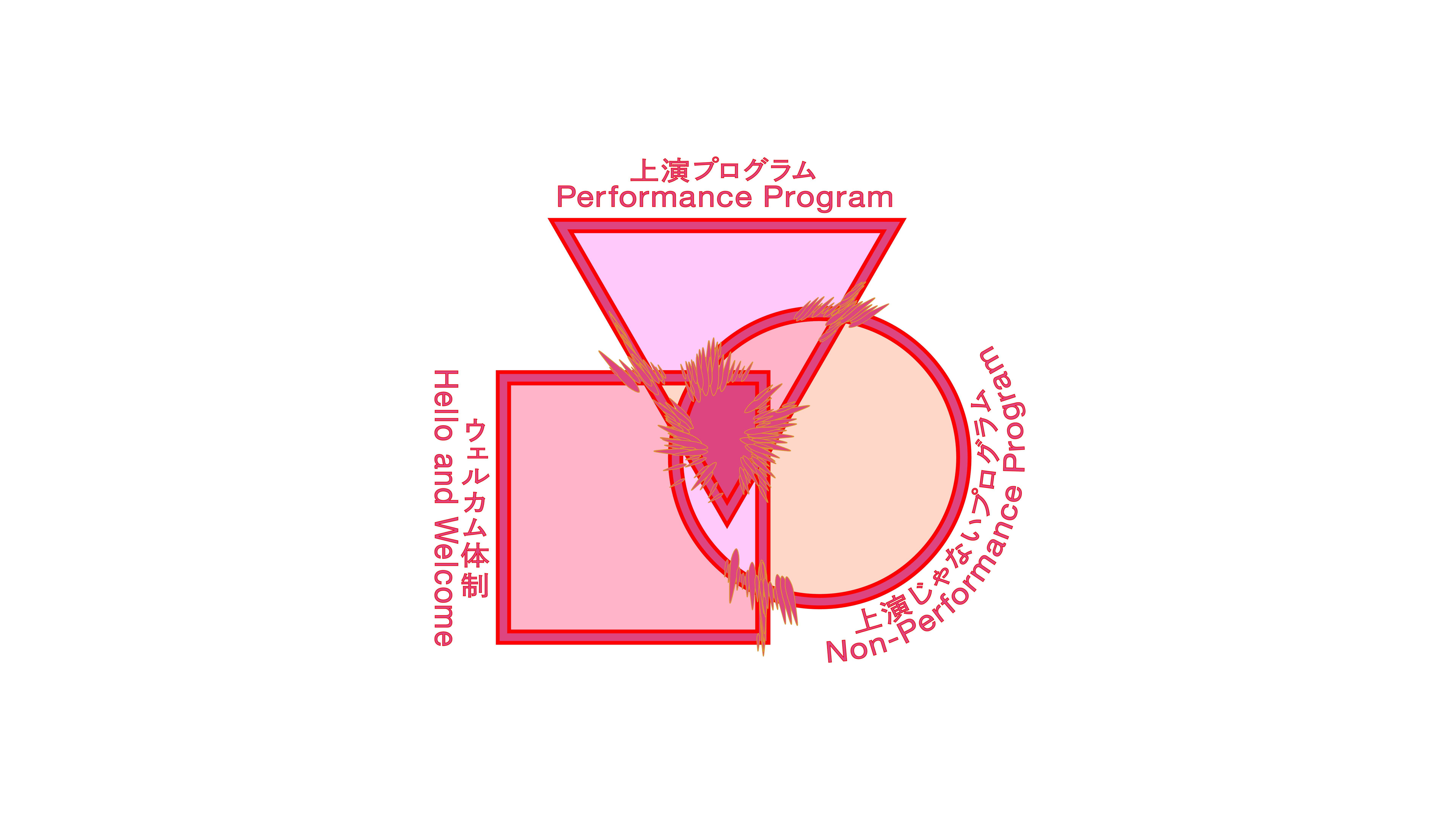
Autumn Meteorite 2025 Tokyo consists of three main components: the Performance Program, the Non-Performance Program, and Hello and Welcome (Attendee Support). The Non-Performance Program includes workshops and talk events, amongst other offerings. The Hello and Welcome refers to our efforts to provide an enjoyable and accessible experience for all, as well as a space where people can gather and rest during the festival.
Of course, the Performance and Non-Performance Programs are meteorites in their own right. But equally important is recognizing the Hello and Welcome framework as a significant meteorite. As a performing arts festival, Autumn Meteorite is not only about projecting the image of a meteorite onto the programs it presents. It also sees the attendees and audience as vital meteorites. Through Hello and Welcome, we aim to expand the scope of who the performing arts can reach, and who they can resonate with. After all, “welcome-ness” is a form of meteorite-ness in itself.
Autumn Meteorite 2025 Tokyo begins with an outdoor performance titled “Another Shape of Reality/Shape of Another Reality.” This phrase was originally conceived as the subtitle for the festival as a whole, and, as such, the title of this performance directly expresses what Autumn Meteorite 2025 Tokyo aims to project onto reality through art. The essence of the phrase will undoubtedly manifest in the performance itself.
“Dance Jurors’ Dance” explores the theme of property, depicting a group of dance award jurors taking part in a dance competition. The idea of property pervades our world, and it is often invoked as a means of protection, yet it undeniably contributes to forces that constrict us. In this dance-theater performance, the concept propels the choreography and playful dance.
We, the living, often ponder the dead, but what if the dead were to think about us? What might that look like? “The Bathhouse of Honest Desires,” co-written and co-directed by Taiwan’s Chia-Ming Wang and Japan’s Kuro Tanino, brings this question to life in a strange and haunting narrative that blends sorrow and humour. Every night in a dilapidated, traditional bathhouse, men who died in war return, “playing” out their desires for women. To witness this work of theater (play) is to undergo an experience that exposes the folly of war in ways both strange and deeply memorable.
As digital technologies such as AI continue to shift the boundaries between fact and fiction—and our ability to reliably perceive reality unravels—UK-based theater company Forced Entertainment presents “Signal to Noise,” a chaotic and chilling piece where deep-fakes are brought to life by flesh-and-blood performers. In this performance, what should be a sanctuary of analog reality (the performing arts) is haunted with a sense of the digital macabre.
For those of us living in a reality where the natural and political conditions for survival are shifting on a planetary scale, Faye Driscoll’s “Weathering” reflects our fate in symbolic, metaphorical, and intensely concrete ways. The ten performers resemble castaways on an ocean raft, intertwined in a frozen stance on a rectangular set positioned within the “acting area” and surrounded on all sides by audience seating. As we observe the subtle, continually shifting movements of the ten performers amongst all the other elements, “Weathering” becomes a storm in itself, gradually overwhelming those who witness it.
Autumn Meteorite seeks to shift and broaden the context in which the performing arts operate. The program “Future Ideations Camp Vol.7 | Super Sober Shamanism: Exploring Synchronization, Co-presence, and Mimesis through Theatre and Technology” is a bold step in that direction, serving as a networking initiative bridging performing and digital arts. While the performing arts may harbor a deep-rooted apprehension toward digital technology, marked by stark differences in values and aesthetics, it is precisely within this tension that new possibilities emerge. Perhaps the performing arts have been waiting thousands of years for a moment like this.
Autumn Meteorite 2025 Tokyo will also highlight the field of Object Theater, through programs curated by Yoko Yamaguchi. Included in the Performance Program are “THE THIRD HAND” by Handa Gote Research & Development and “Things Easily Forgotten” by Xavier Bobés, while a workshop by Ariel Doron is included in the Non-Performance Program. Too often, contemporary performing arts remain bound to human-centered theater. Yet theater need not be confined by the limitations and constraints of human performers. Object Theater—where objects, rather than people, take the stage—offers a vital perspective. Its importance is undeniable, though perhaps underrecognized today. Or perhaps what was once more fully understood about its power has since been forgotten. Autumn Meteorite seeks to build a context wherein Object Theater can be recognized as a meteorite that forges new connections.
Across the world, within the mind, and throughout other layers of reality, countless visible and invisible walls are being built—among them, the divisions between artistic genres. In response, Autumn Meteorite 2025 Tokyo presents “YOU BALANCE” as one of its featured programs. Over the course of two days, musical and non-musical performances will unfold simultaneously across multiple spaces within the Tokyo Metropolitan Theatre. A brackish zone will emerge, where sounds and performances blur and bleed into one another.
Our society continues to throw countless absurdities at women, especially those raising children. Utau-Hahagokoro, a group of mother and non-mother actresses, confronts these challenges with a uniquely powerful form of theater called mothers’ choral theater. Their work does not only speak to mothers raising children: it transcends the context of motherhood to reach all of us who inhabit this society. For this reason, Autumn Meteorite 2025 Tokyo presents their new piece, “The Theater☆Sing! Dance! Grow! A garden of Hahagokoro ~Children's Clothing is Reincarnation~,” as a significant performing arts offering.
Shin Hanagata attempts to transform into something other than human. Severing the perception of his own body as a body, he enters a world revealed through VR goggles—where the image of the body merges with that of objects. Within this realm, he adjusts his posture in pursuit of becoming an object himself. At Autumn Meteorite 2025 Tokyo, an open experiment will be conducted as a prelude to the upcoming presentation of “Ergonomic Embryo,” scheduled for the following year. This work appears to stem from a disquieting yet sincere desire to detach from the state of being human.
SEKITA IKUKO’s theater works invite us to understand the lives we inhabit through the examination of ambience, detail, and the indescribable textures of the air that surrounds us. The company does not put a hierarchy on the components that make up theater: each component is treated equally. Within an exposed space, distinctive acting performances are presented with an exceptionally unique touch, reminiscent of a refined manga drawn in crisp lines. Their performance overflows with ephemeral impressions and emotions that archival stills will almost certainly fail to preserve. And there is laughter, too. The Performing Arts Festival: Autumn Meteorite 2025 Tokyo commissioned SEKITA IKUKO’s new work, “under take,” which began with the idea of revealing a stage mechanism typically concealed from the audience.
Meteorites do not always come from beyond our planet. There is another metaphoric image I want to offer for this performing arts festival: the culvert, a type of subterranean tunnel. A culvert is also a kind of meteorite.
Both meteorites and culverts are defined by context. A meteorite, after all, is just a rock, or large piece of stone, until it arrives. What, then, do we call a meteorite that doesn’t fly toward us? Can Autumn Meteorite extend its context to include these non-flying meteorites? This performance arts festival is a meteorite in its own right, made up of various other meteorites and culverts. As long as we carry the name “meteorite,” we aim to hold these questions close so we can be ready to receive you, another meteorite.